

New genomic evidence reinforces a critical opportunity to broaden access: 40,000 Australians with incurable cancers could potentially benefit

The report – 40,000 Reasons to Act – from the country’s leading not-for-profit precision oncology research organisation Omico – reveals around 40,000 Australians each year could potentially benefit from the world-leading national research program PrOSPeCT (Precision Oncology Screening Platform Enabling Clinical Trials) for those with incurable solid cancers.
The report reinforces the opportunity to act now so our health system keeps pace with the rapid evolution of personalised cancer treatments and the importance of securing a mainstream pathway to broaden access.
To date, Omico has received 40,000 patient referrals across its research programs, from 1,602 clinicians spanning over 150 cancer types. The flagship program, PrOSPeCT, receives one referral every 15 minutes or around 10,000 referrals annually. One in three are from regional/rural areas.
Omico has also built one of the world’s largest and richest precision oncology real-world datasets, comprising 3.2 petabytes of genomic, clinical, treatment and outcomes information from more than 20,000 consented patients. This unique and growing dataset is deepening the understanding of genetic differences between cancers, generating sights into new treatment opportunities and evidence to inform clinical practice, health policy and system reform.
“Over 11 years, Omico has built a national research engine, bringing together the evidence, expertise and capabilities needed to help bridge the gap between scientific discovery and patient access,” states Professor David Thomas, Omico Founder and Chief Science and Strategy Officer. “We now have an opportunity to build on that foundation, accelerate access to innovative treatments and create a health system that continually learns from evidence to improve cancer care.”
Other insights from Omico’s research programs include:
- Omico’s national clinical trial network has expanded by more than 60% over the past two years, from 61 centres (2024) to 99 (2026) including 32 in regional areas.
- In the past year 182 new clinicians referred patients to Omico’s programs.
- Data from Omico’s programs for patients with incurable cancer shows molecular profiling has led to a change in cancer diagnosis for approximately one in 30 participants.
- Data from these programs also shows molecular profiling has identified inheritable cancer risk in around one in 12 participants.
- Published research (MoST program) found patients who received genomically matched treatment had a 65% longer median overall survival than those who received unmatched treatment (21.2 months versus 12.8 months).
Omico’s growing real-world dataset is providing important insights into the potential benefits of genomically matched treatments for people with challenging cancers:-
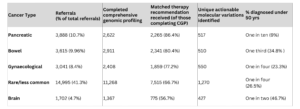
- For pancreatic cancer, where treatment options have historically been limited, Omico has received 3,888 referrals, accounting for one in ten participants across its programs. Emerging data suggests one in five (20%) who received matched therapy survived for five years compared with 4% of those receiving unmatched treatment. Around 85% of pancreatic cancer patients in Omico programs carry mutations which predict this magnitude of benefit.
- Rare cancers also represent a significant proportion of Omico’s cohorts, accounting for almost 15,000 referrals (41.3%). Program data indicates improved survival among those with rare cancers who receive matched tumour-agnostic therapies.
Omico research data (MoST and PrOSPeCT programs):
Omico’s report outlines a coordinated national approach to accelerate advances in cancer care, focussed on two priorities:-
- Expanding access to clinical trials and innovative treatments, including greater clinical trial capacity and more equitable access to molecular profiling and treatment opportunities.
- Accelerating the implementation of effective innovations into routine care, through a nationally coordinated learning health system that generates evidence to inform health policy, funding and implementation decisions, and helping bring effective new treatments into routine care sooner.
Ian Black, Chief Executive Officer and Director of Omico, states: “Australia isn’t starting from scratch. We have world-class research capabilities, and with ongoing Government support, Omico has helped bring together the national research engine, clinical networks and partnerships that have already demonstrated what’s possible.
“We now have the opportunity to bring these strengths together to create a health system that both helps Aussies living with cancer benefit from life-changing cancer treatments sooner, and continually learns and evolves, so Australia keeps pace with scientific discovery and everything it offers.”
The Federal Government made a commitment of $71 million to PrOSPeCT in May this year, supporting a further 25,000 patient referrals and modelling suggests this will enable an estimated 1,133 additional Australians with incurable or advanced cancer reach their five-year cancer survivorship milestone.
*Precision oncology uses molecular profiling (including comprehensive genomic profiling), of a person’s cancer to identify genetic changes that can be matched to advanced targeted treatments and clinical trials.
Download the full report: Omico’s Report: 40,000 Reasons to Act
Download the executive summary: Omico’s Executive Summary